


NHS University Hospital Crosshouse, part of NHS Ayrshire & Arran Health Board, operates a communications and IT environment supporting essential clinical and operational services across the Trust.
Following concerns around the resilience of its existing UPS infrastructure, Linnet Technology was appointed to design and deliver a full system replacement without allowing any interruption to live hospital services.
The Problem
The existing installation comprised two Riello MDT UPS systems installed in 2011 and operating in parallel.
Over time, load growth had eroded the original redundancy. Each UPS was carrying approximately 51% of site load. In a mains failure scenario, if one UPS failed, the remaining unit would have been overloaded, resulting in total loss of protected load.
In practical terms, the system was no longer delivering true N+1 resilience.
Compounding the issue
- No approved shutdown windows
- Previous switching restrictions due to the nature of the load
- Ageing equipment approaching end-of-life phase
- A critical NHS communications hub
The Trust required a solution that would:
- Eliminate overload risk
- Restore genuine N+1 resilience
- Remove single points of failure
- Improve maintainability
- Provide scalability for future growth
- Be delivered with zero downtime
Our Approach
Rather than simply replace like-for-like equipment, Linnet Technology undertook a full engineering review of the site's current and future requirements.
Multiple options were assessed, including:
- Larger standalone UPS replacements
- Reconfigured parallel topology
- Full dual bus architecture
- Modular UPS deployment with built-in redundancy
Given the live environment and the need for staged implementation, we recommended a modular dual bus topology, delivering resilience at both UPS and distribution level.
This approach provided:
- Built-in N+1 redundancy
- Independent A and B supplies
- Improved maintainability
- Simplified future expansion
The Solution
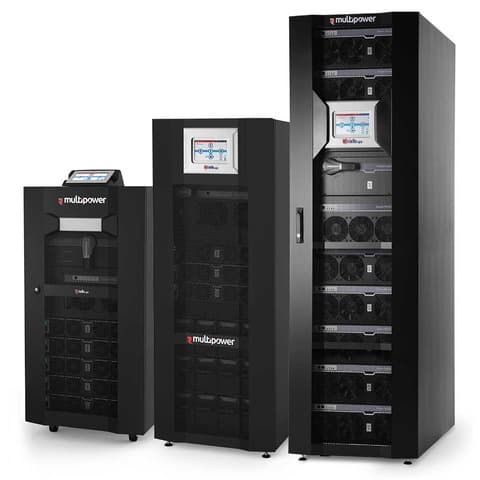
Linnet Technology designed and installed a fully resilient A/B dual bus architecture comprising:
Primary System
- Riello Multi Power (MPW) Modular UPS
- 3 × 42 kW modules
- N+1 redundancy within the frame
- 128 kW installed capacity with future expandability
- Hot-swappable architecture
Secondary System
- Riello Sentryum S3T 100 kVA
- Independent alternate supply
- 100 kW installed capacity
Additional resilience enhancements
- External maintenance bypass switches
- Output synchronisation kit for seamless load transfers
- New distribution boards and upgraded electrical infrastructure
- Full network integration for remote monitoring
Battery autonomy achieved
26 minutes.
Serviceable VRLA battery strings from the existing installation were reused within new battery cabinets, delivering approximately 5% cost saving without compromising runtime or performance.
Energy efficiency improved by approximately 3% compared to the previous system.
Zero Downtime
The defining requirement of this project was uninterrupted operation.
The new UPS systems were installed, commissioned and synchronised alongside the existing infrastructure, which remained live throughout.
Once fully operational:
- Both new systems were tested under load
- Monitoring integration was completed
- Distribution upgrades were in place
Load migration was carried out gradually, circuit by circuit, during normal working hours and entirely at the Trust's convenience.
Only once the new dual bus arrangement was fully supporting the environment was the original 2011 parallel system decommissioned and removed. The transition was completed without a single interruption to service.
The Result
The completed installation now delivers:
- True N+1 resilience at UPS level
- Full A/B dual bus redundancy
- Either UPS capable of supporting 100% of site load
- Reduced electrical single points of failure
- Improved serviceability and maintainability
- Modular scalability without major electrical alteration
- Lower operational risk for the Trust
Maintenance can now be performed on either UPS while the other supports the full site load, removing the operational exposure that previously existed.
The Trust now benefits from a modern, resilient and scalable critical power infrastructure aligned with the operational demands of a live NHS environment.
Project Highlights
- Replaced ageing 2011 parallel UPS system that had lost true N+1 resilience
- Eliminated overload risk where single UPS failure would have resulted in total load loss
- Designed and delivered full A/B dual bus topology in a live NHS comms environment
- Installed Riello Multi Power modular UPS (N+1) and Riello Sentryum 100 kVA system
- Achieved 128 kW + 100 kW installed capacity with either UPS capable of supporting full site load
- Delivered 26 minutes autonomy (19 minutes at end of life)
- Integrated synchronisation kit for seamless load transfers between systems
- Installed new distribution boards and reduced downstream single points of failure
- Reused serviceable VRLA battery strings, reducing project cost by approximately 5%
- Improved overall energy efficiency by approximately 3%
- Fully commissioned and migrated load with zero downtime
- Provided scalable modular architecture for future load growth
- Enhanced maintainability with hot-swappable modular design
Outcome
A zero-interruption upgrade restoring genuine N+1 resilience and significantly reducing operational risk within a mission-critical NHS facility.